



Contents
Scroll to:
Scroll to:
This work is dedicated to analysing the conditions conducive to the spatial succession of individual, extra-tropically persistent species. It also clarifies the distribution of seagrasses (Zosteraceae and Ruppiaceae) in different seas across three oceanic basins and the Caspian Sea, which is part of the inland drainage basin affecting the Russian Federation. A review of herbarium samples and literature on Russian seagrasses revealed five regions that differ in the number of Zosteraceae and Ruppiaceae species: the West Arctic and White Sea (3 species), the Russian section of the Baltic Sea (1 species), the Russian sections of the Black and Caspian Seas and the Sea of Azov (4 species), the south of the Russian Far East (9 species), and the north of the Russian Far East (2 species). The south of the Russian Far East is of particular interest as it serves as a refuge for some seagrasses. This is because they suffer from strong anthropogenic pressure in the main part of their range, which is located further south, whereas in Russia they experience no negative impact. In the Arctic, seagrasses have a wider distribution than was previously thought. This comprehensive study has enabled the development of new approaches to finding seagrass meadows in hard-to-access coastal areas of the Russian Federation, using remote sensing techniques and the assistance of citizen science volunteers.
Iurmanov A., Popov I., Gnedenko A., Lebedev Y., Kulikovskiy M. Seagrasses (Zosteraceae And Ruppiaceae) In Russia: Distribution, Diversity, Prospects For Further Research. GEOGRAPHY, ENVIRONMENT, SUSTAINABILITY. 2025;18(4):139-148.
Seagrasses are a group of underwater plants of the order Alismatales, widely distributed in the coastal waters of all continents except Antarctica (Hogarth 2015). Their aggregations often form ‘underwater meadows’ that resemble terrestrial ones. These meadows are habitats of high conservation value as numerous animals use them. Economic activity in the coastal zone directly or indirectly causes an increase in eutrophication, siltation and turbidity, and these processes harm seagrasses. Intentional extermination of these plants by humans also occurs because dried seagrasses resemble straw and are used as a raw material for the manufacture of various products (Duarte 2002; Short et al. 2011). The underwater meadows are suffering a global decline, and several species are considered threatened (Orth 2006).
A gradual and widespread increase in average annual atmospheric temperatures may, on the one hand, endanger existing seagrass meadows in equatorial and tropical regions due to changes in biotic and abiotic factors. On the other hand, it may contribute to the spread of these seagrasses in the Arctic region. Currently, the Russian Arctic remains an area that is extremely poorly studied in terms of seagrass distribution. This is due to its inaccessibility for research and the seasonality of this work. Seagrasses play an important role as a food source for waterfowl during their annual migrations to the Arctic during the nesting period. The use of satellite imagery is a promising method for assessing the distribution of marine vegetation. Furthermore, due to the changing coastline caused by increasing warming (Tishkov et al. 2023), new areas with potential for seagrass colonisation may form in some locations. This requires further research to better understand these potential habitats.
The ecological value and vulnerability of seagrasses highlight the need for research into their distribution and abundance. Much of the information concerning seagrass distribution in Russian waters is published only in local journals. Consequently, this information is not sufficiently represented in international reviews (Short et al. 2007; Krause-Jensen, 2020), despite being significant, particularly for the Arctic and Far East. We aim to address this gap. Furthermore, our observations of Russia’s coastal waters indicate they serve as a refuge for certain seagrass species. This is because the main parts of their ranges, located further south, experience considerable anthropogenic pressure, whereas in Russia, these species are not negatively impacted. We have gathered such data for one species, Phyllospadix iwatensis Makino (Iurmanov et al. 2022a), and hypothesised that a similar situation applies to other species. This paper evaluates that hypothesis and reviews information on seagrass distribution in Russian waters.
The aim of our research was to investigate the biogeographic distribution of marine Alismatales along the coastlines of the seas surrounding the Russian Federation, including the Caspian Sea. During the research, additional aims emerged. It became clear that it is necessary to develop specialised identification keys based on modern morphological descriptions of species. These keys will help us both during expeditions and when working with herbaria. Furthermore, in the future, we will be able to involve volunteers in clarifying the distribution areas of seagrasses along the coasts of the seas and oceans surrounding Russia. In recent years, scientific volunteerism has been actively developing in our country and has already proved its high effectiveness in the environmental research that we conduct (Shaikina et al. 2022; Tihonova et al. 2023; Vladimirov et al. 2023). Therefore, we decided to compile such a key.
A further additional aim relates to the prospects for further studies. Given that direct observation of vast areas is problematic, the use of remote methods appears promising. The use of satellite remote sensing of the Earth has proven to be an effective and economical method for studying shallow-water coasts (Kravtsova et al. 2021). This research method, limited by periods when a continuous ice cover is established, can be applied along the maritime border of the Russian Federation to identify promising territories for more detailed study (Short et al. 2007). We examined the effectiveness of remote sensing methods for surveying hard-to-reach coastal areas, such as Urup Island in the Kuril Islands and the Tersk Coast of the White Sea.
We developed a key for identifying the studied species based on literature sources and herbarium samples. Additionally, we used remote sensing techniques to conduct field surveys in remote areas such as the Kuril Islands in the Far East and Urup Island.
We gathered publications on seagrass records and the state of their populations by examining the Russian Citation Index and Scopus databases. Additionally, we examined herbarium samples from the following institutions: Komarov Botanical Institute (LE), Saint Petersburg State University (LECB), Tsitsin Main Moscow Botanical Garden of the Russian Academy of Sciences (MHA), Moscow State University Faculty of Biology (MW), and Faculty of Geography (MWG), Institute of Marine Geology and Geophysics Far Eastern Branch Russian Academy of Sciences (SAK), Kamchatka Branch of the Pacific Geographical Institute of the Russian Academy of Sciences (Petropavlovsk-Kamchatsky), and the Herbarium of Kronotsky Nature Reserve (Elizovo). We also consulted the Atlantic Branch of the Institute of Oceanology, P.P. Shirshov, Russian Academy of Sciences (Kaliningrad) (herbarium acronym missing), and the Museum of the World Ocean (Kaliningrad). The GBIF database was also used. Our own observations were conducted from 2017 to 2022 in the Baltic Sea, Sea of Japan, Sea of Okhotsk, and the Pacific Ocean (Iurmanov et al. 2022a; Iurmanov et al. 2022b).
Finally, we characterised the obtained results in accordance with the ‘bioregional model’ of the world’s seagrasses (Short et al. 2007). This involves identifying zones with an equal number of species. We used this model to define which species should be considered seagrasses, focusing on the families Zosteracea and Ruppiacea. This was necessary because there are several intermediate forms between seagrasses and other underwater plants, leading to disagreements among experts regarding definitions. During these studies, we analysed the diagnostic characters of the seagrass species (Tolmachev 1974; Wu et al. 2010) and created a new key for their identification.
When analysing the data collected through remote sensing, we found that multispectral satellite imagery from Sentinel-2, WorldView-2 satellites, and a series of Landsat, IKONOS, and QuickBird-2 satellites was predominant. Additionally, we noted some instances where hyperspectral aerial photography and unmanned aerial vehicles were used in certain studies.
Satellite images from the Landsat series are suitable for mapping the distribution of seagrasses and have been successfully used in this field for a long time (Zharikov et al. 2018). The capabilities of Sentinel satellite imagery are highly appreciated (Kuhwald et al. 2022; Li et al. 2022). However, except in cases where it is necessary to assess the dynamics of seagrass meadow distribution or a long series of satellite images is required, researchers prefer Landsat satellite imagery (Vidya et al. 2023; Pu et al. 2012).
The limited use of satellite imagery for seagrass mapping is due to technical challenges associated with the survey process. Different wavelengths of visible light penetrate water to different depths, and as wavelength increases, penetration depth decreases sharply. Consequently, only a limited number of channels are available for use in most common image processing systems. These channels, including blue, green, and red, form the basis for the primary information that is processed (Fig. 1).

Fig. 1. A generalised scheme for conducting research on seagrasses using remote sensing data
When mapping the distribution areas of seagrass, underwater survey materials are typically used to provide general information about plant distribution patterns within the study area. This study primarily examines the potential use of satellite imagery to identify areas that require more detailed surveying, given limited field data and without the need for extensive underwater surveys. To assess the feasibility of using satellite images, several field observation sites were selected where the presence of seagrass was reliably established. Images from the Landsat-8 and Sentinel-2 satellites, which underwent atmospheric correction, were chosen for dates closest to the field observations (July 7, 2021 for Zostera marina L. and October 9, 2019 for Phyllospadix iwatensis).
Using Sentinel-2 imagery, a distribution map for Phyllospadix iwatensis was prepared in the coastal area of Urup Island. Images that had undergone atmospheric correction were used for automatic interpretation. The reference vector method was chosen as the algorithm for identifying algae habitats, as it has been recognised as one of the most efficient for this purpose (Bakirman et al., 2016; Vidya et al., 2023). To ensure clear coverage of the entire coastline of the island with minimal sea swell, scenes taken on 30 September 2019 were selected as the most suitable based on their quality and coverage for creating the map. The Kuril Islands are generally characterised by a one-month shift in the growth season. In September, the condition of the vegetation cover allows for accurate interpretation.
One of the main challenges in analysing the distribution of seagrass on satellite images is the elimination of interference introduced into the incoming signal by the atmosphere, the sea surface with glare, and the water column. This interference affects the spectral brightness of underwater images and prevents the accurate determination of objects’ true values without the influence of the water column. Atmospheric correction is a standard step in the analysis of any objects from satellite images, but there is debate about whether to correct for the water column and whether this step improves the results. In this study, images with only atmospheric corrections were used to compare visual representations of seagrass meadows in the waters of Russian seas from different survey systems.
Based on the results of this study, we have identified nine species of seagrass with established taxonomic status that grow in the waters of the Russian Federation. These species belong to the Zosteraceae (Zostera marina, Zostera noltii Hornem., Zostera asiatica Miki, Zostera japonica Aschers. and Graebn., Zostera caespitosa Miki, Phyllospadix iwatensis and Phyllospadix juzepczukii Tzvel.) and the Ruppiaceae (Ruppia maritima L. and Ruppia cirrhosa Grande). The distribution of seagrasses in the seas of Russia corresponds to the global bioregional model (Short et al. 2007), but the area of some bioregions is much larger. This applies to the Arctic and the northern part of the Far East. We identified five bioregions for the seagrasses (Fig. 2).

Fig. 2. Bioregions of seagrasses and their species richness: 1. Western Arctic and White Sea, 2. Russian section of the Baltic Sea, 3. Russian section of the Black and Caspian Seas, the Sea of Azov, 4. South of the Russian Far East; 5. North of the Russian Far East, 6. number of seagrass species
Three or four species of seagrass occur in the region. Ruppia maritima, Zostera marina, Zostera noltii were definitely reported, but the occurrence of Ruppia cirrhosa is questionable. The region has been studied very unevenly. At least several tens of articles (Makarov and Spiridonov 2013; Sergienko et al. 2015, etc.) and one monograph (Vekhov 1992) have been published based on studies of a small plot of the White Sea located at its western ‘corner’. However, the rest of the White Sea and the Russian Arctic have been studied hardly at all. This is because three biological stations are located at the western extreme of the White Sea. We found only one herbarium sample of seagrass from the eastern coast of the White Sea. Regarding the Russian section of the Barents Sea, a small number of records are known from the north of the Kola Peninsula at the state border and from Cheshskaya Bay (Vekhov 1992). Furthermore, Zostera marina was reported from Baydaratskaya Bay of the Kara Sea (Vidy — biologicheskie indikatory 2020), and several herbarium samples from the Yamal Peninsula are known (Fig. 3). The state of seagrass populations is considered normal, and the prospects for their commercial use have been discussed (Maksimovich et al. 2005). After a global decline caused by the myxomycete Labyrinthula macrocystis in the mid-20th century, recovery took place (Liubeznova 2013).
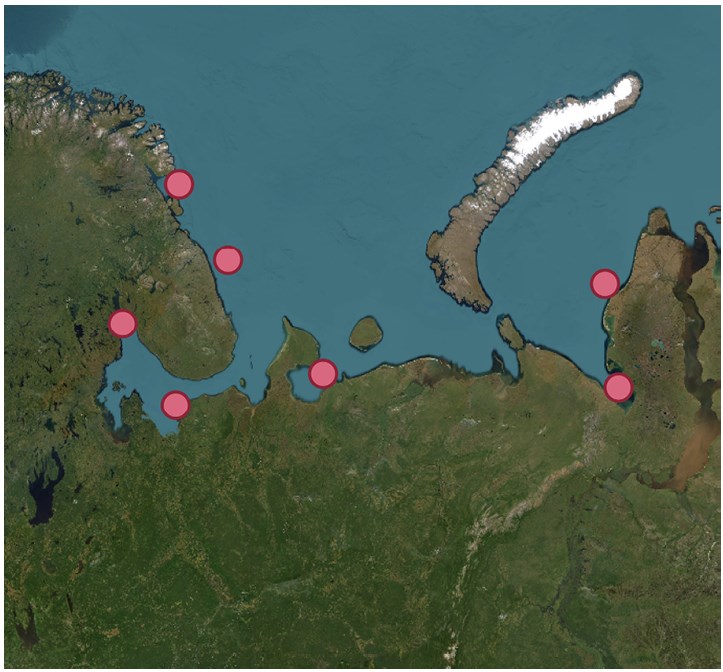
Fig. 3. Zostera marina registration points in the Western Arctic and White Sea Bioregion
The seagrasses are almost absent. In the southern part (Kaliningradskaya oblast), remains of Zostera marina are often found in the wrack, but only one growing specimen is known (Volodina and Gerb 2013). Despite active surveys, no underwater meadows were found there. On the contrary, there is evidence of habitat loss. In 2021, our attempts to find them were similarly unsuccessful. The water was muddy, and algae dominated the seabed. In the centre of the southern section, a sewage treatment plant outlet significantly impacts the surrounding water area. In the northern part (Leningradskaya oblast), we did not find seagrasses, even in the wrack, although we examined the coasts of islands located in the centre of the Gulf of Finland, which is Russia’s western outpost (Iurmanov et al. 2022b).
Four seagrass species are found in this area: Ruppia cirrhosa, R. maritima, Zostera marina, and Z. noltii. They have been studied since the mid-19th century. Most of the information concerns the coastal waters near Sevastopol city (Phillips et al. 2006), though some data for other locations are also available. Seagrasses are present throughout the Russian section of the Black Sea and in the southern part of the Sea of Azov (Milchakova and Phillips 2003; Stepanian 2009). A decline has been reported in areas affected by human activity (Lisovskaya 2011; Teyubova 2012). In a bay near Sevastopol (Kruglaya Bay), a succession of seagrass communities was observed. Initially, Zostera marina dominated, coexisting with Z. noltii, but then Z. noltii took over the site (Mironova et al. 2020). Zostera marina is considered a protected species in Crimea. A reduction in the abundance of Zostera marina was also noted on the northeastern coast of the Black Sea. In the Caspian Sea, a similar situation has been reported: an increase in Zostera noltii and a decrease in Zostera marina down to zero (Stepanian 2016). This occurred due to desalination, siltation, and pollution.
The region includes the coastal waters of Sakhalin, the nearest mainland, and the Kuril Islands. Seven species occur there: Zostera marina, Zostera asiatica, Zostera noltii, Zostera japonica, Zostera caespitosa, Phyllospadix iwatensis, Phyllospadix juzepczukii, Ruppia maritima, Ruppia cirrhosa. Herbarium samples of several other species exist: Phyllospadix scouleri Hook., Zostera pacifica S.Watson, Zostera nana Roth, Zostera angustifolia (Hornem.) Rchb., and Ruppia occidentalis S.Watson. However, these descriptions appear to be synonymous with those already mentioned. Most of the samples were collected near Vladivostok city, at the mouth of the Amur River, in the southern part of Sakhalin, and on Kunashir Island. We added several samples from Iturup and Urup islands (Iurmanov et al. 2022b). Publications indicate some records from the other southern Kurils (Evseeva 2007; Ivanova and Tsurpalo 2017). In general, however, the records cover only a small part of the coastline. Publications on the seagrasses of the Far East are relatively numerous (Aminina 2005; Kulepanov 2005; Blinova et al. 2015; Kulepanov and Drobyazin 2018). Physiological aspects and the role of seagrass as a substrate for fish spawning have been studied (Klimova et al. 2015). Details of their growth have also been investigated (Gusarova 2008; Ivanova and Tsurpalo 2013; Levenets and Turin 2014; Kalita and Skriptsova 2014, 2018; Levenets and Lebedev 2015; Sabitova et al. 2018). A survey of abundance along a long section of the Tatar Strait was carried out (Dulenin 2012). The issue of protection has not been raised. The seagrasses are considered common, and their use for economic purposes was discussed recently (Mitina et al. 2016). No negative trends have been reported.
The northern boundary of the ‘bioregion’ is not entirely clear because collection samples from the northern Kuril Islands and most of the Sea of Okhotsk are not available. Modelling the distribution of relatively southern species (Phyllospadix iwatensis, Zostera asiatica, and Zostera japonica) showed that they could occur up to the southern tip of Kamchatka and approximately the same latitude on the coast of the Sea of Okhotsk. Penetration into some areas of the eastern coast of Kamchatka and the Commander Islands is not excluded. However, seagrasses were studied on these islands, unlike the northern part of the Kuril Islands, and these southern species were not found. Therefore, we drew the boundary of the bioregion through the southern tip of Kamchatka (Fig. 2).

Fig. 4. Registration of seagrasses in the South of the Russian Far East bioregion:
1. Phyllospadix iwatensis, 2. Zostera japonica, 3. Zostera asiatica
The region includes the northern part of the Sea of Okhotsk, the coastal waters of Kamchatka and the Commander Islands, the Russian section of the Bering Sea, and the southern part of the Chukchi Sea. Two species occur there: Zostera marina and Ruppia cirrhosa. Most of the collected specimens are known from the south of Kamchatka, near Petropavlovsk-Kamchatsky City. We also observed Zostera marina there in 2021. Other areas have been studied extremely fragmentarily. It is known that Zostera marina occurs on the Commander Islands (Mochalova and Yakubov 2004). A very small number of collected specimens, references in publications and other documents are known from other sites (Selivanova 2004). The northern border of the region is not well known (Fig. 5). It is believed that Zostera marina lives in the Chukchi Sea (Ministry of Natural Resources 2015). However, it is not known how far northwards it extends. In the neighbourhood, in Alaska, Zostera marina occurs in the southern part of the Chukchi Sea near the Bering Strait (McRoy 1968).

Fig. 5. Places of registration of Zostera marina in the north of the Far Eastern bioregion
We developed a key, based on literature sources and herbarium samples (Tolmachev 1974; Wu et al. 2010), to identify the studied species. This key helps in the identification of families and genera of seagrasses (Table 1), as well as Zostera (Table 2), Phyllospadix (Table 3), and Ruppia (Table 4).
Table 1. Families and genera identification
Level I | Level II | Result |
Leaves 0.5-1.0 m long, narrow, linear (2-9 mm wide). Flowers unisexual, without perianth, collected in flat spikelets | Monoecious; ovary and fruits oval, stems elongated; Leaves 3-9 (11) veined | Zostera L., marine eelgrass |
Dioecious; ovary and fruits cordate, stems short, surrounded at the base by fibers of dead leaf sheaths; Leaves 3-5 veined | Phyllospadix Hook., surfgrass | |
Leaves extremely narrow, linear, probably filiform (in that case up to 15-20 cm). Flowers bisexual, collected in short spikelets | - | Ruppiaceae, widgeonweeds |
Table 2. Zostera species identification
Level I | Level II | Level III | Result |
stems over 50 cm long | Leaves 0.2-1 mm wide, 3-veined, apex apiculate. Stems 10-20 cm long. Inflorescence 1.5 cm long. Fruits smooth, 1.5-2 mm long | - | Zostera noltii Hornem. |
Leaves over 1 mm wide, stems over 20 cm long | Leaves 1.5-2 mm wide, apex rounded, 3-veined. Stems 20-30 (40) cm long. Fruits smooth, about 2 mm long, elliptical or narrow cylindrical | Zostera japonica Aschers. et Graebn. | |
Leaves 3-6 mm wide, apex rounded, 5-7 veined. Stems up to 60 cm long. Fruits grooved, about 3.5 mm long, elliptical. Abundant creeping rhizomes, internodes short | Zostera caespitosa Miki | ||
stems up to 50 cm long | Leaves 4-6 (8) mm wide, 5-7 veined, apex rounded. Stems 60-100(150) cm long. Fruits oblong, grooved, about 4 mm long | - | Zostera marina L. |
Leaves 10-15 mm wide, 9 (11) veined, apex apiculate. Stems up to 100 Stems. Fruits oblong, smooth, about 5 mm long | - | Zostera asiatica Miki |
Table 3. Phyllospadix species identification
Level I | Result |
Leaves 2-4.5 (5) mm wide, 5 or 3 veined, apex rounded, finely serrated. Fibers of dead leaf sheaths are abundant. Retinacules apiculate | Phyllospadix iwatensis Makino |
Leaves 1.2-2.7 mm wide, 3 veined, apex rounded, finely serrated. Fibers of dead leaf sheaths at the base of the stem are few in number. Retinacules rounded | Phyllospadix juzepezukii Tzvel. |
Table 4. Ruppia species identification
Level I | Result |
Leaves 2-5 mm wide, apex apiculate. Stems 20-50 cm long. Peduncle strongly elongated (up to 10 cm or more), twisting into a spiral. Fruits ovoid or obliquely ovoid | Ruppia cirrhosa Grande |
Leaves about 5 mm wide, apex apiculate. Stems up to 20 cm long. Peduncle 1-3 cm long, non-twisting. Fruits ovoid and curved | Ruppia maritima L. |
The maps were prepared to compare the capabilities of visual interpretation of seagrass meadows at field observation stations in remote regions, specifically on the Tersk Coast of the White Sea and on Urup Island in the Kuril Ridge (Fig. 6).

Fig. 6. Typical aggregation of Zostera marina (A) on the Tersk Coast of the White Sea (Photo by Mikhail Kuznetsov) and Phyllospadix iwatensis (B) on Urup Island in the Kuril Ridge at the northern coast of Urup Island (Photo by Anton Iurmanov)
It is noticeable that in the Landsat-8 image (Fig. 7) Zostera meadows are hardly visible because their distribution area captures a narrow but long strip of coastal shallow water. This makes them difficult to recognise at a spatial resolution of 30×30 metres from the image size. In contrast, the Sentinel-2 image allows for more accurate visual interpretation of the meadows and also provides extensive opportunities for automated processing.
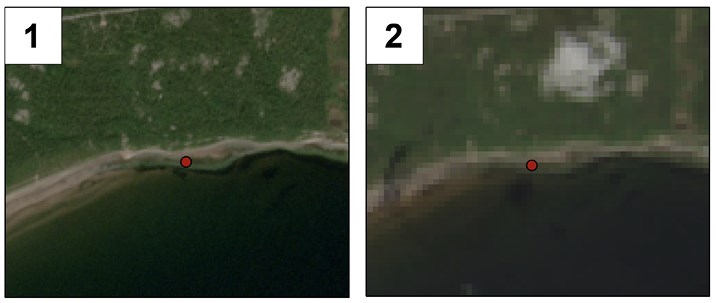
Fig. 7. Location of the point of discovery Zostera marina (Russia, Murmansk region) in pictures: 1. Sentinel-2, 2. Landsat-8
A similar pattern can be observed in the Phyllospadix iwatensis sites located on the northern tip of Urup Island. A map of the distribution has been prepared for the coastal area of this island, showing that seagrasses are connected to gentle rock outcrops on the coastal cliffs and occupy relatively small areas (Fig. 8). At the same time, they are distributed fairly evenly along the coastline of the island and do not show a strict proximity to any particular coast. To a large extent, the distribution of Phyllospadix iwatensis is influenced by the structure of the coastal bottom, as all potential areas for its growth are limited to gentle rock formations at shallow depths.
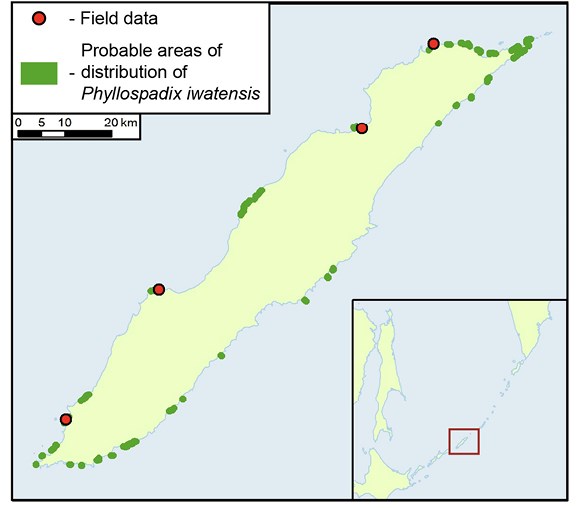
Fig. 8. The location of the identified and probable ranges of Phyllospadix iwatensis in the coastal waters of Urup Island (Kuril Islands, Russia), established by remote sensing
The dispersal of Alismatales plants occurs both vegetatively and through seed dispersal. However, there have not yet been enough studies to determine how long plant parts with roots and leaves can survive outside the substrate. Although long-distance dispersal is not common, it plays a significant role in the formation of new areas (McMahon et al. 2014). Based on this information, we can assume that these types of settlements could be the beginning of seagrass habitat formation (Iurmanov 2022; Iurmanov 2023).
Our observations of seagrass emissions on the shores of Russia indicate the complexity of the settlement process. The remains washed ashore appear to have grown elsewhere previously. However, if there are no large seagrass meadows close to the shore, no significant accumulations of emissions have been found. These emissions once again suggest that seagrass is distributed very unevenly across the water area. Several factors limit its occupation of new areas, ranging from substrate composition to human activity (Iurmanov et al. 2022).
In the case of Phyllospadix iwatensis, we found that it can grow in both surf-protected coastal areas and in areas affected by waves. This is thanks to its dense and robust turf, which allows the species to tolerate the substrate. It can therefore grow in surf zones as a habitat-forming agent and occupy new habitats, unlike Zostera marina and Zostera asiatica (Iurmanov et al. 2022b), which cannot do this. The fruits of Zostera asiatica have a thick cuticle that prevents water from entering them before they open and release the seeds (Iurmanov et al. 2021). In the non-opening fruits of Phyllospadix iwatensis, our research found that they are similar to Prunus-type drupes. They have a differentiated inner sclerenchymal bone formed by the inner zone of the mesocarp and endocarp. Aerenchyme is also formed in the outer zone of the mesocarp in these fruits (Iurmanov et al. 2021). This fruit structure has adaptations for both hydrochory and endozoochory. The aerenchyme ensures the buoyancy of the single-seeded, non-opening diaspores, while the fruit bone mechanically protects the seeds from destruction.
Thus, although the specific habitats of various marine higher plant species indicate that the successful transfer of fruit or plant parts is insufficient for their establishment, and such material also requires optimal conditions, different adaptations for hydrochoric dispersal allow them to gradually expand their range and form new populations far from the original location (Iurmanov 2022; Iurmanov 2023).
The state of seagrasses in the southwest and west of Russia is similar to the usual situation in populated areas. They have survived in some locations, but overall, their numbers are declining. It is highly probable that they have recently become extinct in the Russian sector of the Baltic Sea. In the Black and Caspian Seas, their condition is also deteriorating. In the past, the remains of seagrasses on the shores were so numerous that they were actively used for economic purposes (Morozova-Vodyanitskaya 1939). However, this is no longer an issue as no commercial ‘deposits’ are available.
The biogeographical context of Russian Arctic seagrasses is particularly interesting. They have been found to be more widely distributed than previously thought (Krause-Jensen et al. 2014, 2020). Some authors previously believed that the Arctic was entirely unsuitable for seagrasses due to a lack of light (Blinova et al. 2014). However, they do exist there. Furthermore, their distribution is likely expanding (Krause-Jensen et al. 2014, 2020). As global warming progresses in the Arctic, seagrass populations may increase. This suggests that at least Zostera marina will gain new habitats. However, assessing these prospects is challenging. It is known that seagrasses can survive under ice (McRoy 1969). Nevertheless, the environment in the inner parts of the Russian Arctic is unlikely to be favourable for them. Despite global warming, conditions remain very cold. Arctic seas are primarily warming due to warm currents from the south. However, Novaya Zemlya Island acts as a barrier, meaning only the Barents Sea is warming rapidly.
The seas of the Russian Far East are particularly valuable for seagrasses. This might be because this region is thought to be a centre of origin for the Zosteraceae family (Iurmanov 2022), and consequently, a hotspot of their diversity. In addition to Zostera marina, several other species are found there. Some of these are considered vulnerable globally and have relatively small distribution areas. They were mainly described in the coastal waters of Japan, Korea, and the nearest Chinese territories. In the main part of their range, they are declining due to habitat loss. It has been found that they are quite widespread in the adjacent Russian territories. The usual factors that negatively impact seagrasses are not present there. At the same time, considering global warming, we might expect an expansion of their range and an increase in their numbers. Other seagrasses may also establish themselves there. However, studying this process presents a challenge. In the past, these plants attracted attention as a source of various products, but relevant research is now conducted rarely. Further improvement of remote sensing methods and the involvement of volunteers would help to address this.
To implement scientific volunteer projects aimed at monitoring the distribution and species diversity of marine meadows, we prepared an accessible guide for identifying seagrass species found in the seas surrounding the Russian Federation (Table 1–4). We also needed a unified framework for an observation system focused on phenology (Vladimirov et al. 2023). The importance of studying the phenology of seagrasses in Russia is determined by both fundamental tasks of studying habitat formation processes and practical tasks related to sustainable development. These include the ecosystem role of marine meadow communities in carbon dioxide fixation, primary production, creating shelter and a food base for marine animals, and protecting against coastal erosion.
These observations can be conducted in various locations, such as submerged seagrass beds, in the tidal zone, on the surface of waves, or washed ashore. Volunteers should record external factors such as the date, depth, water and air temperature, salinity, and describe the substrate. It will be important to identify the species of seagrass and determine whether it is a single plant or part of a meadow. They should also note the phenological stage (vegetative, budding, flowering, fruiting, or dying) of the seagrass. Additionally, volunteers may collect data on biomass. The organisation of this scientific volunteering project can serve as the basis for calibrating remote sensing techniques for marine meadows and determining the precise distribution of seagrass in Russia. This information can then be used to monitor its dynamics over time.
The seas of the Russian Far East are becoming a refuge for threatened sea grasses, which are declining in neighbouring southern areas. Seagrasses in the Russian Arctic are more widely distributed than previously thought and are probably expanding. Using remote sensing techniques, in conjunction with citizen science projects, will allow us to complete work on creating updated and detailed maps and inventories of seagrass flora, as well as establish a monitoring system.
1. Aminina N. (2005). Main trends of the studies on algae and sea grasses of Far East. Isvestiya TINRO, 141: 348-354 [In Russian with English summary].
2. Blinova E., Yermakov I., Kamnev A., Krupina M., Stukolova I. (2014.) Grass weeds of the Russian seas: ecology, distribution, stocks, history of research. Part 2. Grass weeds of the north-west seas of Russia. Regional environmental issues, 5: 119-125 [In Russian with English summary].
3. Blinova E., Yermakov I., Kamnev A., Krupina M., Stukolova I. (2015). Seagrasses of the Russian seas: ecology, distribution, stocks, history of investigation. Part 3. Seagrasses of the Far Eastern seas of Russia. Regional environmental issues, 6: 16-27 [In Russian with English summary].
4. Duarte C. (2002). The future of seagrass meadows. Environmental Conservation, 29: 192-206.
5. Dulenin А. (2012). Resources and distribution of commercial macrophytes in the western Tartar Strait (Khabarovsk Territory). Izvestia TINRO, 170: 17-29 [In Russian with English summary].
6. Evseeva N. (2007). Macrophytobenthos of the coastal zone of southern Kuril Islands. In: Biology, state and environment of hydrobionts in Skhalin-Kuril region and its coastal waters. Proceedings of Sakhalin institute for fisheries. SakhNIRO, 9: 125-145. [In Russian].
7. Gusarova I. (2008). Macrophytobenthos of the northern Amur Bay. Izv TINRO, 155: 88-98 [In Russian with English summary].
8. Hogarth P. (2015). The Biology of Mangroves and Seagrasses. 3rdEd. Oxford etc.: Oxford University Press.
9. Iurmanov A., Romanov M., Bobrov A. (2021). Fruit morphology and histology of Zostera asiatica Miki and Phyllospadix iwatensis Makino (Zosteraceae) in connection with сomparative carpologу of Higher Alismatales. Botany Letters, 168(4): 1-7.
10. Iurmanov A., Popov I., Romanov M. (2022a). Seagrasses At The Islands Iturup And Urup Of Kuril Archipelago. Geography, Environment, Sustainability, 4(15): 39-43.
11. Iurmanov, A., Romanov M., Gerb M., Volodina A., Baikova I., Popov I., Markovets M. (2022b). Seagrass Zostera In the Russian Section Of the Baltic Sea. Geography, Environment, Sustainability, 2(15): 111-115.
12. Iurmanov A. (2022). Phylogenetic phytogeography of selected groups of seagrasses (Monocotylendoneae - Alismatales) based on analysing of genes 5.8S rRNA and RuBisCo large subunit. Geography, Environment, Sustainability, 15(1): 61-69.
13. Iurmanov A. (2023). Phylogenetic phytogeography of higher Alismatales: Posidoniaceae, Ruppiaceae, Cymodoceaceae, Zosteraceae, Potamogetonaceae: dis. ... kand. Biology 1.5.9. / Iurmanov A.A. Moscow. 206 p. [In Russian].
14. Ivanova M., Tsurpalo A. (2013). Composition and distribution of macrobenthos communities in the intertidal zone of Putyatin Island (Peter the Great Bay, Japan Sea). Izv. TINRO, 172: 149-160 [In Russian with English summary].
15. Ivanova M. and Tsurpalo A. (2017). The Phyllospadix iwatensis community in the intertidal zone of the Far Eastern seas of Russia. Izvestia TINRO, 188, 173–180 [In Russian with English summary].
16. Kalita T. and Skriptsova A. (2014). Current status of subtidal macrophyte communities in Ussuriysky and amursky bays, Sea of Japan. Russian Journal of Marine Biology, 40, 6. 427-434 [In Russian with English summary].
17. Kalita T., Skriptsova A. (2018). The Current State of the Zostera marina + Stephanocystis crassipes Community in the Eastern Bosphorus Strait, Sea of Japan. Russ J Mar Biol, 44: 25-35.
18. Klimova A., Klyukina R., Bonk A. and Klochkova N. (2015). The role of sea weeds in formation of spawning substrate of Pacific herring. Vestnik Kamchat GTU, 31, 60 – 66 [In Russian with English summary].
19. Kravtsova V., Vakhnina O., Chalova E. (2021). Methodological problems of studying the underwater relief in the river delta from satellite images (using the example of mapping the shoals of the Yenisei Delta). Water Resources, 48(4): 378-389.
20. Krause-Jensen D., Duarte C. (2014). Expansion of vegetated coastal ecosystems in the future Arctic. Frontiers in Marine Science, 1, 10.
21. Krause-Jensen D., Archambault P., Assis J., Bartsch I., Bischof K., Filbee-Dexter K., Dunton K., Maximova O., Ragnarsdóttir S., Sejr M., Simakova U., Spiridonov V., Wegeberg S., Winding M., Duarte C. (2020). Imprint of Climate Change on Pan-Arctic Marine Vegetation. Frontiers in Marine Science, 7.
22. Kulepanov V. and Drobyazin E. (2018). Species composition and quantitative distribution of seaweeds in the sublittoral zone and on the continental slope in the northwestern Japan Sea. Izvestiya TINRO, 195, 151–160 [In Russian with English summary].
23. Kulepanov V. (2005). Researches of macrophytobenthos at the coast of Primorye. Izvestiya TINRO, 141, 355-364 [In Russian with English summary].
24. Levenets I., Tyurin S. (2014). Macrophytes of Vostok Bay, Sea of Japan Biodiversity and Environment of Far East Reserves. Biodiversity and Environment of Far East Reserves 1: 36-48 [In Russian with English summary].
25. Levenets I. and Lebedev E. (2015). Diversity of the intertidal macrophytes of Far eastern marine biosphere reserve FEB RAS (Peter the Great bay, sea of Japan). Proceedings of Dalrybvtuz, 36, 37-48 [In Russian with English summary].
26. Lisovskaya O. (2011). Macrophytobenthos of the upper sections of shore zone of Russian coast of Black Sea. SPbGU, Saint-Petersbirg [In Russian].
27. Liubeznova N. (2013). Zostera is coming out of crisis. Priroda, 2: 95-96 [In Russian].
28. Makarov A., Spridonov V. (2013). Sea grasses: view from the cosmos. Priroda, 2: 91-94 [In Russian].
29. Maksimovich N., Ivanov M., Bukina M. (2005). Modern status and prospects for trade of sea grass Zostera marina L. in coastal waters of the Karelian coast of the White Sea. In: The study, sustainable use and conservation of natural resources of the White Sea. Proceedings of the IXth International Conference, 208-210. Petrozavodsk, 2005.
30. McMahon K. (2014). The movement ecology of seagrasses. Proc. Biol. Sci., 281(1795): 1-9.
31. MсRoy C. (1968). The Distribution and Biogeography of Zostera marina (Eelgrass) in Alaska. Pac Sci, 22(4): 507-513.
32. MсRoy C. (1969). Eelgrass under Arctic Winter Ice. Nature, 224: 818-819.
33. Milchakova, N.A., Phillips, R.C. 2003. Black Sea seagrasses. Marine Pollution Bulletin, 46, 695-699.
34. Ministry of Natural Resources and Ecology of the Russian Federation. Order No. 25-r dated September 22, 2015 On Approval of the List of Flora and Fauna Species that are Indicators of the Sustainable State of Marine Ecosystems in the Arctic Zone of the Russian Federation [In Russian].
35. Mironova N., Pankeeva T. (2020). Spatio-temporal changes in the macrophytobenthos of Kruglaya Bay (Black Sea). South of RussiaEcology Development, 15: 125-139.
36. Mitina N., Malashenkov B. and Gordeev A. (2016) An Assessment of Natural Resource and Economic Potential of the Coastal Waters of the Middle Primorye. Gosudarstvennoye upravleniye, Elektronnny Vestnik. 58, 147-163 [In Russian with English summary].
37. Mochalova O., Yakubov V. (2004). Flora of Commander islands. BPI DVO RAN, Vladivostok. [In Russian].
38. Morozova-Vodianitskaya N. (1939). Zostera as an Object of Gathering in the Black Sea. Priroda, 8, 49-52. [In Russian].
39. Orth R. (2006). A Global Crisis for Seagrass Ecosystems. BioScience, 56, 987–996.
40. Phillips R., Milchakova N., Alexandrov V. (2006). Growth dynamics of Zostera in Sevastopol Bay (Crimea, Black Sea). Aquatic Botany, 85: 244-248.
41. Popov I., Iurmanov A. (2024). Recent surveys of the sea otter (Enhydra lutris) population on Kuril Islands. Pacific Conservation Biology, 30(6): 1-9.
42. Sabitova L., Skriptsova A., Cherbadgy I. (2018). Oxygen exchange and primary production of Zostera japonica Аscherson et Graebner, 1907 community in the Golubinyi Bay (Sea of Japan). Russian Journal of Marine Biology, 44,5: 415-423.
43. Selivanova O. (2004). Macrophytes of Russian shoal of Bering Sea, Commander islands and south-eastern Kanchatka. Dr. Thesis Kazan University [In Russian].
44. Sergienko L., Starodubtseva A., Smolkova O., Markovskaya E. (2015). Species of the genus Zostera L. (fam. Zosteraceae) in the flora of the western coast of White Sea. Fundamentalniye issledovaniya, 2-12: 2606-2612 [In Russian].
45. Shaikina M., Shipilina L., Gladilin A., Simakova K., Iurmanov A. (2022). Approaches to involving volunteers in solving phytoinvasion. In: Phytoinvasions. Materials of the All-Russian Scientific and Practical conference with international participation, 463-468. Moscow University Press, Moscow. [In Russian].
46. Short F., Carruthers T., Dennison W., Waycott M. (2007). Global seagrass distribution and diversity: A bioregional model. Journal of Experimental Marine Biology and Ecology, 350: 3-20.
47. Short F., Polidoro B., Livingstone S., Carpenter K., Bandeira S., Bujang J., Calumpong H., Carruthers T., Coles R., Dennison W., Erftemeijer P., Fortes M., Freeman A., Jagtap T., Kamal A., Kendrick G., Kenworthy W., La Nafie Y., Nasution I., Orth R., Prathep A., Sanciangco J., van Tussenbroek B., Vergara S., Waycott M., Zieman J. (2011). Extinction risk assessment of the world’s seagrass species. Biological Conservation, 144: 1961-1971. Stepanian O. (2009). Distribution of macroalgae and seaweed in the Azov Sea, Kerch Strait, and Taman Bay. Oceanology, 49: 361-367.
48. Stepanian O. (2016). Macrophytobenthos of the Caspian Sea: Diversity, Distribution, and Productivity. Oceanology, 56: 395-405.
49. Teyubova V. (2012). Raznoobrazie i ekologicheskie osobennosti makrofitobentosa rossijskogo sektora Chyornogo morya. PhD Thesis. Krasnodar, Kubanskij gosudarstvennyj universitet. [In Russian].
50. Tikhonova N., Ukhatova Yu., Zavarzin A., Vladimirov D., Iurmanov A. (2023). Fruits of the future: the results of the Fruits of Science project. Proceedings on Applied Botany, Genetics and Breeding, 184(2):245-250 [In Russian].
51. Tolmachev A. (1974). Determinant of higher plants of Sakhalin and the Kuril Islands. L.: Nauka. 372 P [In Russian].
52. Vekhov V. (1992). Zostera of the White Sea. Moscow: Moscow State University. (In Russian).
53. Vidy — biologicheskie indikatory sostoyaniya morskih arkticheskih ekosistem. (2020). Moskva: Fond «NIR». 383 pp. [In Russian].
54. Vladimirov D., Gladilin A., Gnedenko A., Glukhov A., Grudinskaya V., Zdravchev N., Lebedev P., Minin A., Mironenko I., Senator S., Simakova K., Tikhomirova A., Shaikina M., Shipilina L., Shiryaev A., Iurmanov A., Yantser O. (2023). The methodology of conducting phenological observations. Alpina PRO. Moscow [In Russian].
55. Volodina A. and Gerb M. (2013). Macrophytes of the coastal zone of the Russian sector of the southeastern part of the Baltic Sea (Kaliningrad region). Izvestiya KGTU, 28, 129-135. [In Russian with English summary].
56. Wu Z., Raven P., Hong D. (2010). Flora of China. Vol. 23 (Acoraceae through Cyperaceae). Science Press, Beijing, and Missouri Botanical Garden Press, St. Louis.
st. Kapitana Egorova, 15, Murmansk 183038
st. Botanicheskaya, 35, Moscow, 127276
n. Universitetskaya, 7/9, Saint-Petersburg, 199034
st. Staromonetniy, 29, Moscow, 119017
st. Miklukho-Maklaya, 6, Moscow, 117198
st. Botanicheskaya, 35, Moscow, 127276
Iurmanov A., Popov I., Gnedenko A., Lebedev Y., Kulikovskiy M. Seagrasses (Zosteraceae And Ruppiaceae) In Russia: Distribution, Diversity, Prospects For Further Research. GEOGRAPHY, ENVIRONMENT, SUSTAINABILITY. 2025;18(4):139-148.
 Email this article (Login required)
Email the author (Login required)
Email this article (Login required)
Email the author (Login required) 
Editor-in-Chief
Kasimov Nikolay S.Lomonosov Moscow State University
Moscow 119991 Russia, Leninskie Gory, Faculty of Geography, 1806a
Phone +7 495 939-15-52
E-mail: ges-journal@geogr.msu.ru





